
Hartley Projected Release Meaning
TDCJ defines a Projected Release Date as the date calculated by Classification and Records for release from incarceration if the person is not paroled sooner. The calculation can reflect the offense date, offense, sentence, mandatory-supervision eligibility, time credits, and later Board action. It is not a court promise. It also differs from parole eligibility, a favorable Board vote, a scheduled release, physical departure, and final discharge.
A pretrial detainee at Dallam-Hartley County Jail usually has no calculated prison date. Release may depend on bond, dismissal, a plea, a sentence, or another court order. A local sentence may instead end after credit calculations. The jail release entry supplies the departure time, while the court record explains the legal basis.
Find a Hartley Projected Date
Begin by distinguishing the joint county jail from Dalhart Unit. For a TDCJ prisoner, use the official Online Inmate Search. Enter accurate identifying information, compare matches, and open the linked name rather than relying on a results summary.
- Confirm whether the person is in county or TDCJ custody.
- For TDCJ, search by name and available TDCJ or state identifiers.
- Open Offender Information Details and copy the exact field label.
- Separate projected release, parole eligibility, scheduled release, and maximum expiration.
- Check for a scheduled release location when one is displayed.
- Verify a near-term date through TDCJ release channels.
If an expected TDCJ record is absent, use the no-charge offender-information email service. With a seven-digit TDCJ number, send the full name and number. Without it, TDCJ asks for the exact birth date or approximate age plus county of conviction. Telephone and formal public-information routes are also available. A no-result does not prove there was no prison history.
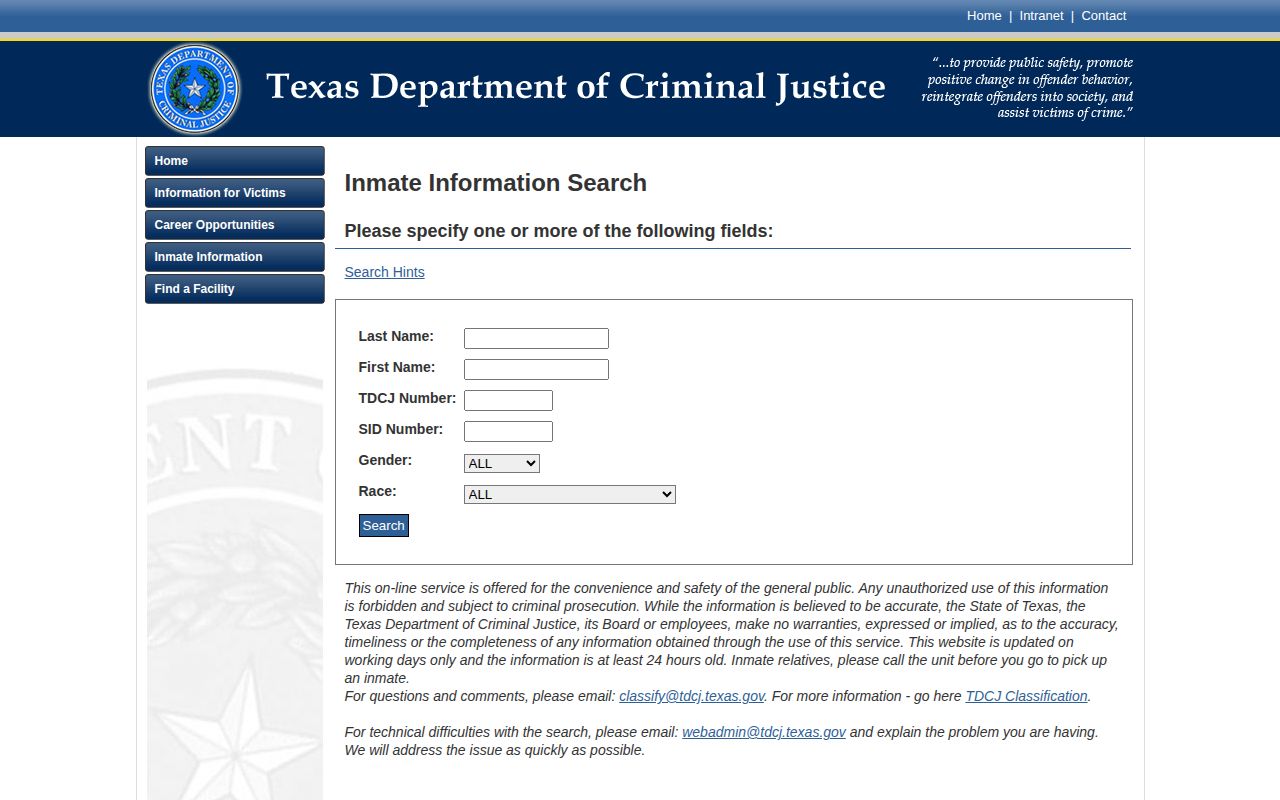
The official TDCJ search form is the starting point for a state-prison date.
Hartley Release Date Fields
TDCJ records may show several milestones. Each answers a different question, and none should be silently relabeled as “release date.”
| Field or event | Meaning |
|---|---|
| Parole eligibility | The first point at which Board consideration may be possible, not a release order. |
| Projected release date | The Classification and Records estimate if parole does not occur sooner. |
| Scheduled release date | A planned date after further processing, still subject to change. |
| Scheduled release location | The place identified for processing when that field appears. |
| Maximum expiration | The sentence endpoint shown by TDCJ, subject to the record's exact terms. |
| Discharge | The end of the sentence or supervision obligation, not merely prison departure. |
The TDCJ definitions page is the best source for field meaning. Preserve the “as of” date. When two official sources conflict, contact the physical custodian first and report the mismatch instead of choosing the preferred date.
Texas Time Credits and Release
Texas Government Code Chapter 498 governs good conduct time. Under Section 498.003, those credits are a privilege, not a vested right. They can affect eligibility calculations where the law permits, but they do not reduce the sentence itself. Credits can be forfeited for disciplinary violations. Restoration is discretionary and certain serious disciplinary cases restrict it.
There is no truthful universal “serve 85 percent” rule for Texas prisoners. Eligibility depends on the offense, date, sentence, enhancements, and exclusions in Government Code Chapter 508. Section 508.145 contains offense-specific parole rules, while Sections 508.147 and 508.149 govern mandatory-supervision processing and exclusions. A calculation copied from another case can be wrong.
- Good conduct time
- A statutory credit used in permitted eligibility calculations; it does not rewrite the sentence.
- Parole
- Conditional release under supervision before sentence discharge.
- Mandatory supervision
- A statutory release form subject to eligibility and review rules.
- Detainer
- A request or hold that may send a person to another custodian.
Why Hartley Release Dates Change
Review and Release Processing checks far more than a date. TDCJ reviews the release plan, county-of-residence rules, disciplinary status, required programming, and special conditions before issuing a certificate. Classification audits and work on a residence plan can add time after a favorable Board decision.
| Change | Possible effect |
|---|---|
| New time-credit audit | Moves the projection after records are recalculated. |
| Disciplinary action | May reduce credits or delay processing. |
| Parole Board action | Can approve, deny, condition, or reconsider release. |
| Required program | Completion may be required before release processing ends. |
| Residence or release plan | An unapproved plan can delay a certificate. |
| Detainer or court order | May cause transfer to another authority instead of community release. |
The Review and Release Processing page describes this work. The key distinction is physical custody. An approved or scheduled person remains confined until TDCJ completes the release or transfers custody.
Hartley County Jail Dates
For the joint jail, call 806-244-2541 and identify the booking with enough detail to avoid a name mismatch. Ask for the current custody status and whether an existing release entry identifies date, time, disposition, authority, and any receiving agency. Pair that entry with the Hartley County and District Court case. A bond order, dismissal, judgment, or sentence explains why release could occur, but it does not by itself prove the exact time the door opened.
A transfer from the joint jail to TDCJ, another county, USMS, or ICE is not community release. Once custody changes, the receiving agency controls the next projected date. For a true local release, the joint jail is the physical custodian. For a Dalhart Unit release, TDCJ controls. The Hartley County VINELink Inmate Search explains the separate notification portals.
Note: Near a planned date, verify again because a court order, hold, time audit, or processing step may change the outcome.
Hartley Parole Dates Need Context
Parole eligibility is not a date on which release must occur. The Texas Board of Pardons and Paroles reviews a file and may vote for or against release, impose a condition, or set further review. A favorable code must be read with its conditions and later TDCJ processing status. The Board decides parole while the Parole Division and Classification and Records complete other parts of release processing.
After approval, TDCJ may still need a verified residence, required programming, a time audit, and a release certificate. A scheduled location can also matter. The Hartley association does not mean the person will walk out of Dalhart Unit into Hartley County. TDCJ may process release elsewhere, transfer the person, or deliver the person to another authority. Ask what location and event the detail actually shows.
Mandatory supervision is not automatic sentence discharge. Exclusions and Board review can apply, and supervision may continue after prison. A maximum-expiration date marks a different milestone. Only the current record establishes whether the person is confined, scheduled, released under supervision, or discharged.
Document a Hartley Date Check
Write down the matching identifier, portal, exact field label, displayed date, and time reviewed. Keep “projected,” “eligible,” “approved,” “scheduled,” “released,” and “discharged” separate. If the field changes, the saved wording explains what happened.
For a county sentence, request jail and court records instead of applying a TDCJ formula. Ask the joint jail about credited time and the physical release entry. Ask the sentencing court for the judgment and later orders. The research found no Hartley-specific formula, weekend rule, or guaranteed release hour, so none should be assumed.
For TDCJ, the detail page is primary online evidence. Email and telephone add fallbacks, while a formal request can seek incarceration history, release, discharge, and supervision data. Confirm a near-term date shortly before travel. A projection helps planning, but it is not a promise about the hour of departure.
Search Public Records
Sponsored Results
Confirm Hartley Release Processing
A favorable parole decision begins another stage rather than proving departure. TDCJ checks a proposed residence, discipline, required programs, and special conditions. Classification and Records audits the time calculation. The release certificate follows that work. A person can therefore have an approval code and projection while still confined.
The scheduled location needs the same care as the date. It may identify where TDCJ plans to process the event, but it does not establish where the person will live or whether another authority will take custody. Do not assume Dalhart Unit remains the release site because it was listed earlier.
A court sentence, parole eligibility date, Board result, release certificate, and physical departure are distinct records. Keeping each milestone separate prevents a preliminary date from being reported as an actual Hartley County release.
Note: Check a near-term date again with the responsible release channel because a later time audit, hold, or processing step may alter it.
Keep the latest official field label with the date so each later revision remains clear and traceable.